Table of Contents
ToggleSummary
Medically Reviewed by Dr. Deepthi Jammi (MS – OB/GYN – Fetal Medicine Specialist)
- An anomaly scan is a detailed ultrasound done between 18 and 22 weeks of pregnancy. It is also called a TIFFA scan or 20-week scan.
- The anomaly scan accuracy rate is generally high, especially for detecting major abnormalities. However, it cannot guarantee 100% accuracy.
Introduction
An anomaly scan is one of the most important pregnancy scans, usually done between 18 and 22 weeks. It is also known as a TIFFA scan (Targeted Imaging For Fetal Anomalies).
Its main purpose is to evaluate the baby’s physical development and to identify any structural abnormalities early.
But naturally, one common question comes up – how accurate is an anomaly scan? Can it ever be wrong?
Book an Anomaly Scan with Dr. Deepthi Jammi Today
How Accurate is An Anomaly Scan?
The TIFFA scan accuracy is generally high.
Research shows that a single-stage screening detects around 50.5% of abnormalities.
However, when it is combined with first-trimester screening (a two-stage approach), the detection rate improves significantly to about 83.8%.
A Study shows that detection can vary widely, from around 33.3% for digestive tract abnormalities, 93.6% for skeletal dysplasias, to about 95.7% for abdominal wall abnormalities.
Can an Anomaly Scan be Wrong?
An anomaly scan is a highly reliable screening tool, but like any medical test, it also has some limitations.
9 Abnormalities that an Anomaly Scan May Miss
An anomaly scan is a highly reliable prenatal scan, but like any medical test, it also has some limitations.
In some cases, a few abnormalities may not be detected due to certain factors:
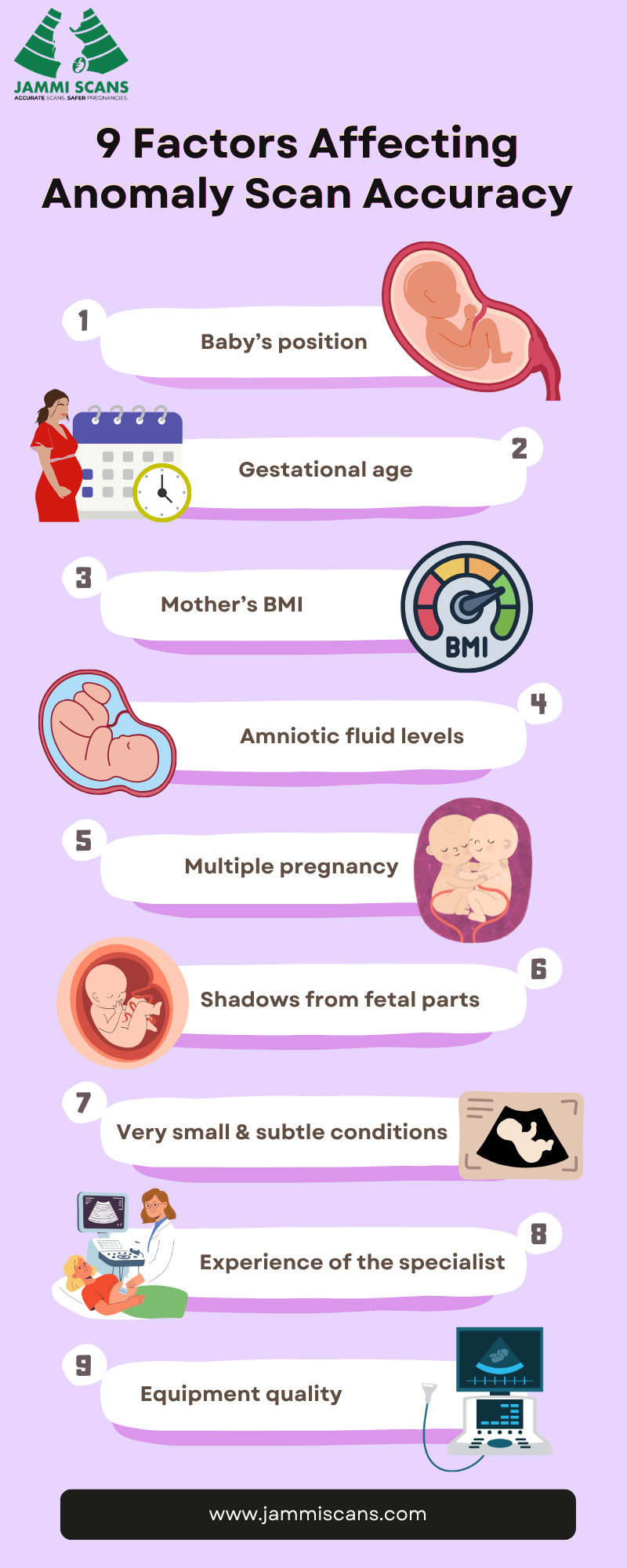
- baby’s position
- gestational age
- mother’s BMI
- amniotic fluid levels
- multiple pregnancy
- shadows from fetal parts
- very small and subtle conditions
- the experience of the specialist
- equipment quality
But this is relatively uncommon, especially when performed by experienced fetal medicine specialists using good-quality equipment.
What Abnormalities Can Anomaly Scan Miss?
Some abnormalities are more difficult to identify, such as;
1. Heart Defects
Heart-related issues are among the most common anomaly scan missed conditions.
Some major defects, like heart chamber abnormalities, are easier to detect during the scan.
But smaller issues, such as a tiny hole between the heart chambers, can be much harder to identify.
2. Small or Subtle Abnormalities
- Tracheoesophageal Fistula – a condition where there is an abnormal connection between the food pipe and windpipe.

- Imperforate Anus, where the baby is born without a normal opening for passing stool (Missing Anus or incorrectly formed).
- A genetic condition that causes gradual muscle weakness over time, called muscular dystrophy.
- An isolated cleft palate, which occurs only in the oral cavity and is not visible outside.
- Abnormalities of the nerves and internal structure of the eyes.
- Small genital structural defects that are too small at this stage.
3. Conditions that Develop Later in Pregnancy
Studies show that abnormalities like
- hydrocephalus
- certain brain conditions
- heart defects
- kidney disorders
- lung lesions
- intestinal blockages
are often diagnosed after 20 weeks, as the baby continues to grow and organs mature.
Also, Read What are the Abnormalities Detected in an Anomaly Scan.
Reasons Why Anomaly Scans May Not Be Accurate?
Several practical factors can affect the anomaly scan accuracy rate, such as:
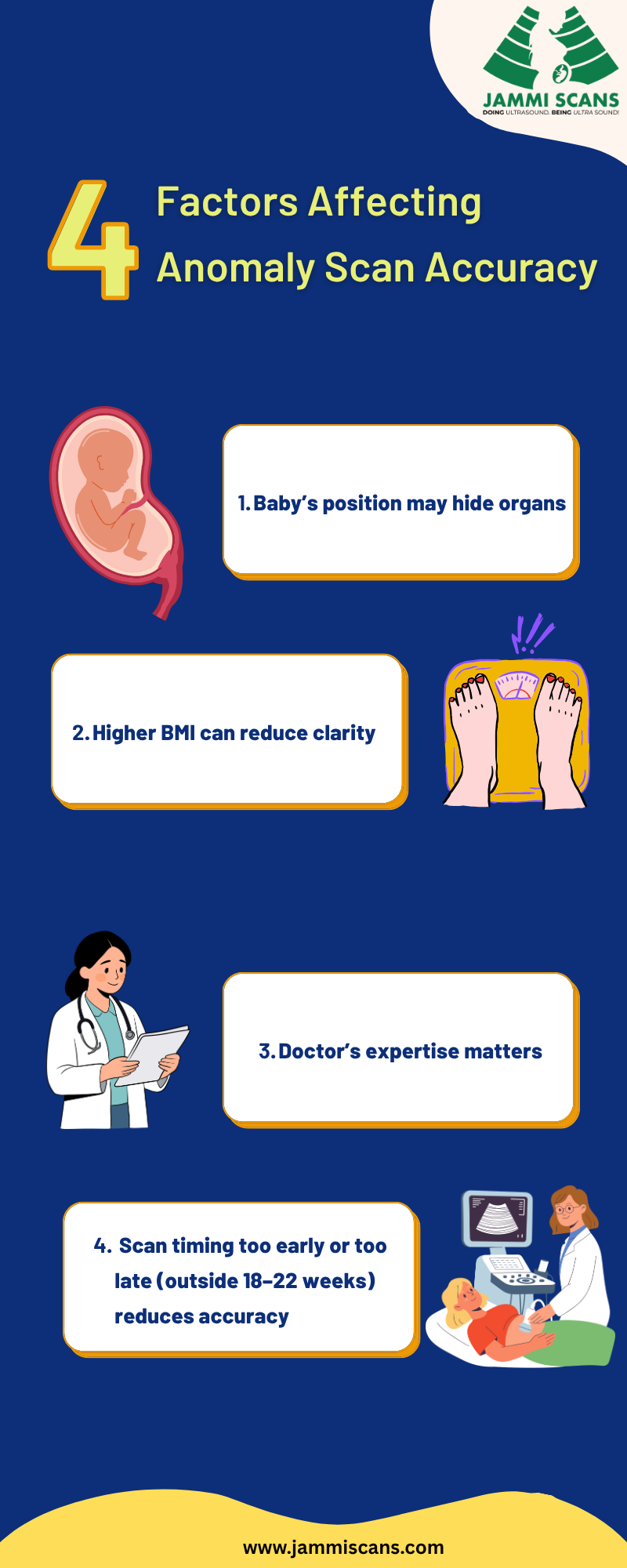
- If the baby is not in a favourable position, some organs may not be clearly visible.
- Mother’s higher BMI can sometimes reduce image clarity, making a detailed assessment more difficult.
- An inexperienced doctor is one of the biggest factors. A trained fetal medicine specialist can identify even subtle abnormalities more accurately.
- Doing the scan outside the recommended 18–22 week window can impact the 20-week scan accuracy.
What Happens If Anomaly Scan Results Are Abnormal?
The doctor usually recommends:
- Follow-up scans to confirm findings
- Second opinion from a fetal medicine specialist
- Genetic testing, such as amniocentesis, if required
- Genetic counselling to understand the situation and the next steps
How to Improve the Accuracy of an Anomaly Scan?
A few simple steps can help get the most accurate results.
1. Choose an Experienced Scan Centre
The expertise of the fetal medicine specialist can greatly improve anomaly scan accuracy rate and reduce the chances of missed findings.
2. The right time
18-22 weeks is the ideal time for a 20-week scan accuracy, as the baby’s organs are developed for proper assessment.
3. Follow your doctor’s instructions
Simple steps like staying hydrated or adjusting your position during the scan can help get clearer images.
Conclusion
An anomaly scan is a crucial pregnancy ultrasound that helps detect structural abnormalities in the baby.
To ensure the best possible accuracy, it is important to choose a scan centre with an experienced fetal medicine specialist, as they can identify even subtle findings.
At Jammi Scans, Dr. Deepthi Jammi performs all anomaly scans with great precision, helping expectant parents feel reassured and well-informed.
Contact 7338771733 to book your anomaly scan appointment.
If you’re looking for a trusted place, Jammi Scans is known as one of the leading pregnancy scan centres in Chennai.
With an FMF-certified fetal medicine specialist, Dr. Deepthi Jammi, the focus is always on detailed evaluation and giving you clear, reassuring guidance at every step.
FAQ
1. Is the anomaly scan 100% accurate?
While an anomaly scan is highly accurate, often detecting up to 85–90% of major structural anomalies, it does have certain limitations.
Hence, it may not detect every condition with complete certainty, including some minor heart defects or conditions that develop later in pregnancy.
2. Can an anomaly scan miss abnormalities?
Yes, an anomaly scan can miss some abnormalities.
Some conditions may be too small to detect, may develop later in pregnancy, or may be difficult to assess clearly due to reduced visibility or other technical limitations during the scan.
3. Can a normal anomaly scan still have problems later?
The scan checks your baby’s development at that stage (around 18-22 weeks), and most babies with a normal scan continue to grow perfectly well.
In some cases, a few conditions may develop later. Routine follow-up scans are done to regularly check your baby’s growth.
Reviewed by Dr. Deepthi Jammi - Fetal Medicine Specialist
Dr. Deepthi Jammi (Director, Jammi Scans) is a qualified OB/GYN and Post-Doc in Maternal Fetal Medicine. As a pregnancy ultrasound expert, she is passionate about healthy pregnancies and works towards spreading awareness on the latest diagnostic options available for parents to choose from. Dr.Deepthi has received gold medals and awards in Fetal Medicine at international and national conferences, and has appeared in numerous prestigious regional magazines and TV interviews.