Table of Contents
ToggleSummary
- An anomaly scan report shows how your baby is developing at 18–22 weeks.
- A normal report means no major structural issues were seen during the scan.
- If anything unusual is found, your doctor may suggest further tests or follow-up scans.
Introduction
An anomaly scan is one of the most important milestones during pregnancy. It gives a detailed view of your baby’s physical condition around the 5th month.
Does it mean everything is completely fine? Or is there more to understand?
Let’s know about the normal anomaly scan report in detail.
Schedule an Anomaly Scan with Dr. Deepthi Jammi Today
What Does a Normal Anomaly Scan Report Indicate?
A normal anomaly scan report generally indicates the following:
- The baby’s major organs, including the brain, face, spine, heart, abdomen, and limbs, appear to be developing normally.
- No visible structural abnormalities are detected during the scan.
- The baby’s growth measurements are appropriate for the gestational age.
- The placenta, amniotic fluid, and other pregnancy-related structures appear normal (if assessed).
A normal anomaly scan is reassuring and indicates that your pregnancy is progressing as expected.
However, it is still essential to attend all scheduled prenatal appointments and scans, as they help your healthcare provider monitor your baby’s growth, development, and overall well-being throughout your pregnancy.
What is checked on the anomaly scan?
The important things that the anomaly scan report checks are:
- Fetal movement and activity
- Key measurements (head, abdomen, femur) to assess size and growth
- Heartbeat and heart structure (chambers and valves)
- Head, brain, face, and spine formation
- Organs like the stomach, kidneys, bladder, and intestines
- Limbs, including hands and feet
- Placenta position and function
- Amniotic fluid levels
- Umbilical cord structure
Anomaly Scan Report Explained
Sample Anomaly Scan report Explained:
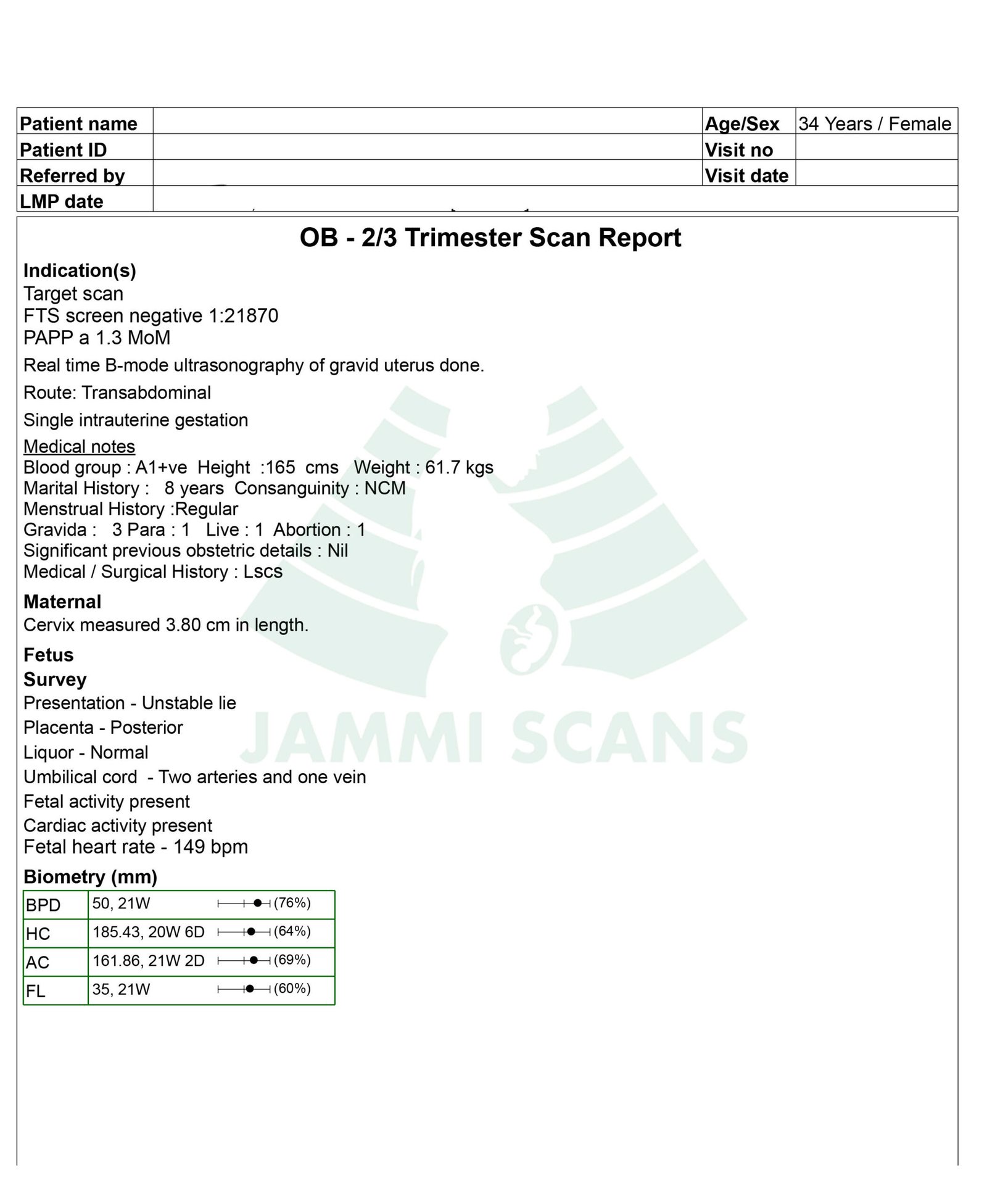
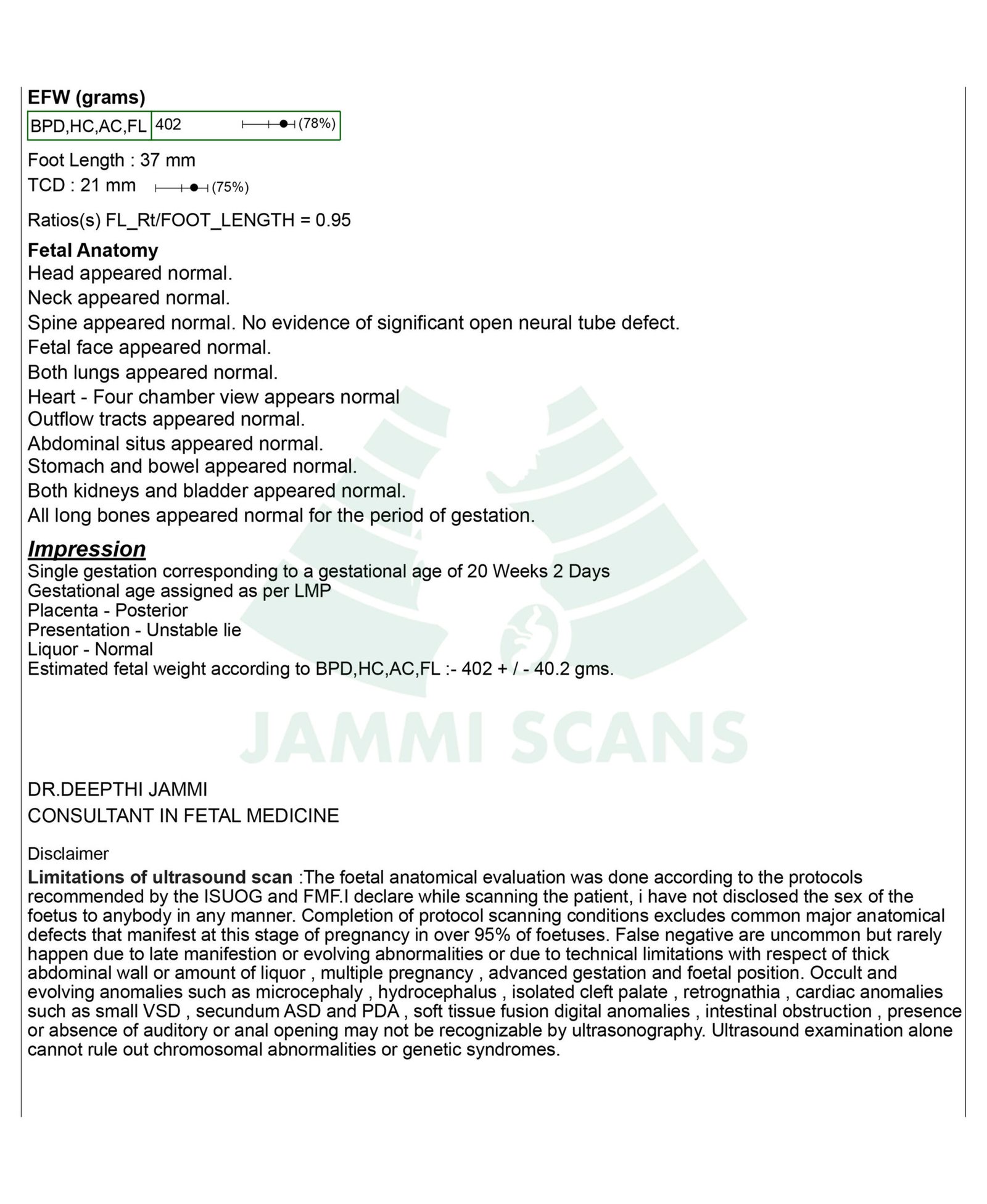
1. Basic details:
The fetal anomaly scan report has a few of the basic details, like the mother’s age, marital status, blood group, height, weight, etc.
2. Measurements:
What are normal measurements in an anomaly scan?
There are a few measurements of the fetus that are taken during the anomaly scan.
So for the anomaly scan results to be normal, the measurements should be appropriate to the gestational age of the baby.
The measurements are as follows:
Biparietal diameter (BPD):
The diameter between the two sides of the head is measured and the value is called BPD.
Head circumference(HC):
The head circumference, or HC, is the size of the fetus’s head.
Abdominal circumference (AC):
This is yet another important measurement in the anomaly scan
Femur length (FL):
This measures the body’s longest bone and shows how long the fetus has grown.
3. Placenta:
Other important information that is present in the anomaly scan report is the placement of the placenta (posterior placenta, anterior placenta, fundal placenta, and lateral placenta) and the umbilical cord, which should ideally have 2 arteries and 1 vein.
4. Heart rate:
Since anomaly scans can monitor the heartbeat of the baby to check for any issues, the report has details of the fetal heart rate too.
For a 20-week-old fetus, the ideal heartbeat should be around 110 to 180 BPM.
5. Cervix length:
Apart from these details, the report has the cervix length, which should ideally be around 30-40mm or 3-4cm during the 20th week of gestation.
6. Fetal anatomy:
The anomaly scan report analysis also provides information called fetal anatomy, which reads the size of the baby’s head to detect any chromosomal abnormality.
The head size should be normal for the baby to have a very low chances of having any chromosomal abnormalities.
7. Spine:
Neural tube defects are one of the common conditions all babies are checked for.
The anomaly scan determines if the fetus’s spine is normal and if there is a sign of neural tube defects.
8. Body measurements:
The anomaly scan also checks the baby’s spine, face, lungs, stomach, kidneys, bladder, etc. and makes sure that they are all normal.
9. Liquor:
The amount of fluid present in the womb that surrounds the baby is called liquor or amniotic fluid that helps with the baby’s lungs, digestive system, and muscles development.
Considering the values in the above report by considering the values given, we can conclude that the anomaly scan report analysis is normal and the chances of the baby having any abnormality is very low.
Does a Normal Report Mean the Baby Is Completely Healthy?
While a normal anomaly scan report is reassuring, it doesn’t guarantee that the baby is completely healthy, because the scan focuses on visible structures.
- Some conditions, such as growth restriction and fluid in the baby’s brain, can develop after an anomaly scan.
- Certain conditions, such as small holes in the heart, can be too subtle to be detected during an anomaly scan.
- Chromosomal or genetic conditions, such as Down syndrome, may not always show changes in the baby’s physical structures.
This is why it is crucial to attend all scheduled prenatal appointments and scans to monitor your baby’s overall development and well-being throughout your pregnancy.
Why is a Normal Anomaly Scan Important?
- Lower the likelihood of major birth defects
- Confirms that your baby’s major organs appear normal
- Reduce anxiety and give you peace of mind
What Happens After a Normal Anomaly Scan?
After a normal report, your doctor’s focus shifts to regular monitoring. Unless there are specific concerns, no additional tests are needed.
Your doctor may recommend:
- Regular check-ups
- Follow-up scans to track growth
- Maintaining a healthy lifestyle and diet
When Should You Still Follow Up With Your Doctor?
Even with a normal report, you may still need to follow up if:
- You have a high-risk pregnancy
- There is a family history of genetic conditions
- You notice unusual symptoms
- Your doctor advises additional screening
Why is it important to choose the Right Pregnancy Scan Centre in Chennai?
The accuracy of an anomaly scan depends on how well it is performed and interpreted.
Both the specialist’s expertise and the quality of the equipment are important. A trained fetal medicine specialist plays the most crucial role.
At Jammi Scans, Dr. Deepthi Jammi, an FMF-Certified Fetal Medicine Specialist with over 15 years of experience, performs anomaly scans using the GE Voluson Expert 22, one of the world’s most advanced ultrasound systems.
This enables detailed fetal evaluation and accurate diagnosis, helping ensure the best possible care for both mother and baby.
A well-equipped scan centre ensures:
- Clear imaging and detailed evaluation
- Better detection of subtle abnormalities
- Accurate interpretation of the report
- Reliable guidance for next steps
Conclusion
A normal anomaly scan report means your baby’s development looks healthy at that stage, and no major structural concerns were found.
However, it’s important to remember that this scan is just one step in your pregnancy journey.
Regular follow-ups, proper medical guidance, and choosing the right scan centre play key roles in ensuring a healthy outcome for both you and your baby.
At Jammi Scans, Dr Deepthi Jammi, an FMF-certified fetal medicine specialist, carefully evaluates every anomaly scan report in detail, explaining what every finding means and providing you with the right care throughout your pregnancy.
FAQ
1. Can a normal anomaly scan report still miss some conditions?
Yes. An anomaly scan mainly detects visible structural defects. So conditions that are subtle, develop later, or do not affect structure may not be identified
2. Will I need more scans after a normal anomaly scan?
Yes, you may still need more scans. Pregnancy care involves regular monitoring. So, your doctor may recommend follow-up scans to track your baby’s growth and well-being.
3. What is the normal FL at 28 weeks?
At 28 weeks, the average femur length (FL) is around 5.3-5.5 cm.
4. Should I still be careful during pregnancy after a normal report?
Absolutely. Even with a normal report, taking care of your health, eating well, and attending regular check-ups all continue to play an important role.
5. Can growth problems appear later after a normal anomaly scan?
Yes, growth problems can appear later. The scan reflects findings at that stage, and the growth patterns can change as pregnancy progresses.
6. Does a normal report mean normal delivery is guaranteed?
No, it doesn’t. Delivery depends on several factors later in pregnancy, including the baby’s position, growth, and the mother’s health.
7. Can a baby have problems even after a normal anomaly scan?
In most cases, a normal anomaly scan report indicates that your baby appears to be developing well at that stage. However, some conditions may not be visible during the scan or may develop later in pregnancy.
8. Is a normal anomaly scan enough to avoid further testing?
Even after a normal anomaly scan, your doctor will usually recommend a growth scan, mostly done during the third trimester (28-32 weeks). Additional tests may also be advised based on your medical history, risk factors, or your doctor’s advice.
9. How accurate is a normal anomaly scan report?
A normal anomaly scan report is generally quite accurate in detecting major structural abnormalities.
But it may miss some conditions that are too small to detect, develop later in pregnancy, or that don’t involve visible structural changes.

Reviewed by Dr. Deepthi Jammi - Fetal Medicine Specialist
Dr. Deepthi Jammi (Director, Jammi Scans) is a qualified OB/GYN and Post-Doc in Maternal Fetal Medicine. As a pregnancy ultrasound expert, she is passionate about healthy pregnancies and works towards spreading awareness on the latest diagnostic options available for parents to choose from. Dr.Deepthi has received gold medals and awards in Fetal Medicine at international and national conferences, and has appeared in numerous prestigious regional magazines and TV interviews.